Build the Agent or Power the Agent?
Ch01.084 Build the Agent or Power the Agent?
📊 Level ⭐ | 6.4KB |
entities/p-build-the-agent-or-power-the-agent.md
Build the Agent or Power the Agent?
Published Time: 2026-06-24T22:09:58+00:00
Markdown Content: I’m Tanay Jaipuria, a partner at Wing and this is a weekly newsletter about the business of the technology industry. To receive Tanay’s Newsletter in your inbox, subscribe here for free:
Hi friends,
A question I keep coming back to with founders is some version of this: should you build an agent, or should you power the agent your customer is already using?
For a growing number of people, the default place they do knowledge work is now a horizontal agent: Claude Code/Cowork, Codex, Copilot. That’s where the day starts and where a lot of the tasks already happen.
So if you’re building a product, you face a fork. Either you try to become the agent for some set of users, the thing they open instead of the horizontal one. Or you accept that they live in the horizontal agent and show up there, powering it for the slice you’re good at.
In this piece, I’ll cover:
-
What “build the agent” and “power the agent” actually mean
-
How to figure out which way you lean
-
What doing both entails realistically
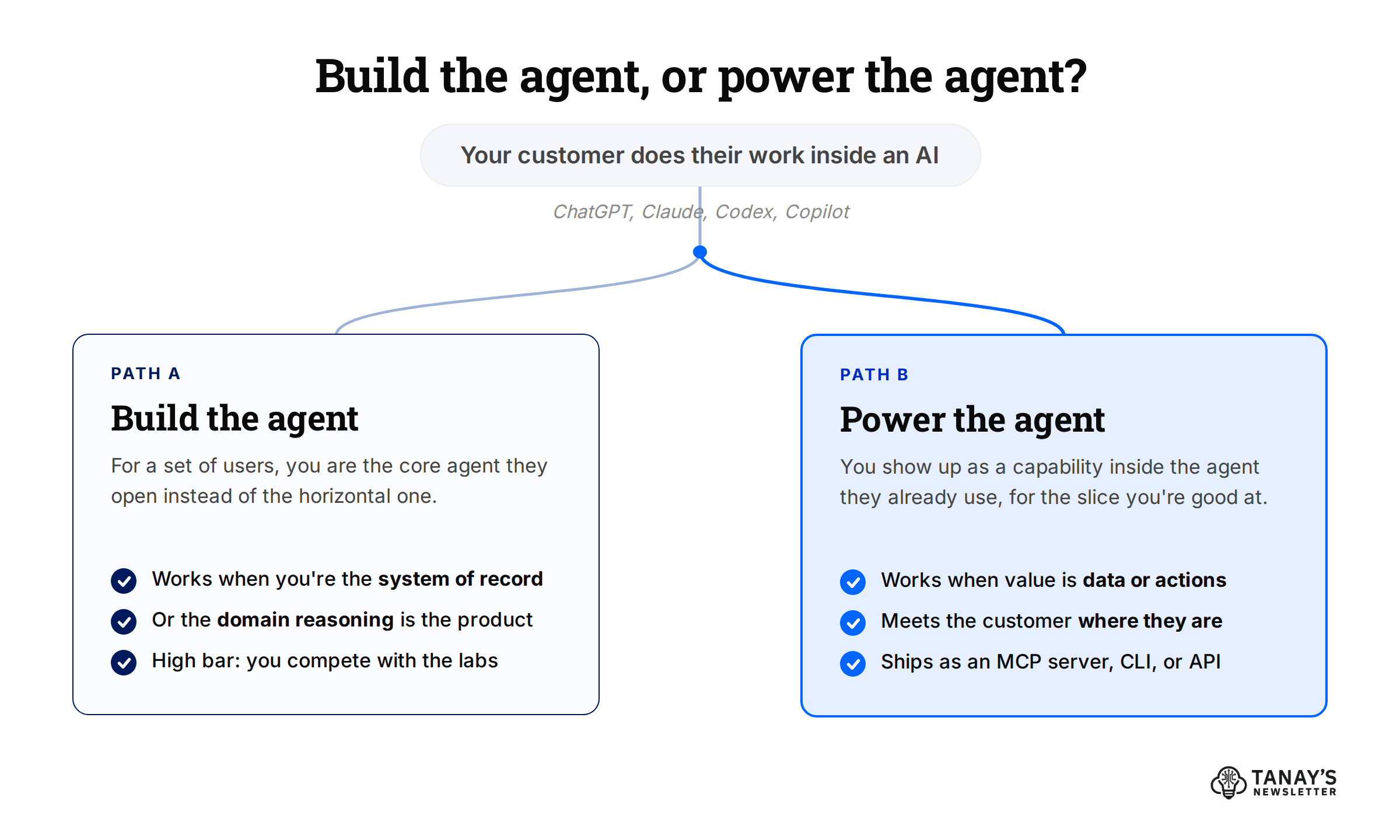
Building the agent means that for some set of users, you want to be the core agent. Not as a connector inside Claude / ChatGPT, but the core interface they open instead of it.
The appeal is obvious. You own the interface and you capture the usage and are the go to across the jobs to be done the user has.
The catch is that you increase friction for adoption of your product and are now going heads up against ChatGPT / Claude Cowork / Codex, etc.
It can make sense in two cases. The first is when you’re the system of record (and or action/engagement already), so your users already live in your product all day and a native agent inside it beats sending them elsewhere. The second is when the domain reasoning is the product, where the work is specialized enough that a horizontal agent can’t do it well enough. Both essentially mean that your product is verticalized enough that for some subset of users it can be the core agent they use on a daily basis.
Harvey is one example. It’s betting that for lawyers, it can be the core agent rather than a feature inside a horizontal one. The same logic holds for other vertical players going deep on a single profession. The bet is that the work is specific enough to justify a dedicated agent.
As general harnesses improve however, there is a risk that some competitors in these verticals take a “power the agent” approach and meet customers where they are - in another horizontal agent.
If a general agent already does most of someone’s job, convincing them to switch to yours for a slice of it is a hard sell.
The other path is to accept that your customer lives in a horizontal agent, and make that agent better at your domain instead of trying to replace it.
The usual form is an MCP server but a clean CLI or a well designed API built with agents in mind also works as well.
You are essentially building a version of your product meant to be used and consumed by an agent, most often a horizontal agent.
So what value does your product provide in this case?
-
Data and Context. Some products are valuable because of the data and actions they sit on, not because of any interface, and the move is to expose that data to wherever the customer already is. Some good examples include Granola which launched an MCP to allows its context to be consumed by agents.
-
Capabilities and Actions. The other value lever is to broaden or improve the set of capabilities and actions that the horizontal agent can take by giving it access to your product. One example of this is Higgsfield, an image and video generation platform, which ships an MCP server so that horizontal agents can use their reasoning and ability on orchestration and leverage Higgsfield’s products expertise in rendering and generating images and videos.
In practice, most taking this approach will want to find ways of adding value in both dimensions - data/context and capabilities/actions.
Its interesting to see that the incumbents are moving in this direction as well. Salesforce announced “Headless 360” in April 2026, exposing the whole platform as APIs, MCP tools, and CLI commands, with the framing that the API is the UI. HubSpot followed with a remote MCP server giving any compatible agent read and write access to CRM data.
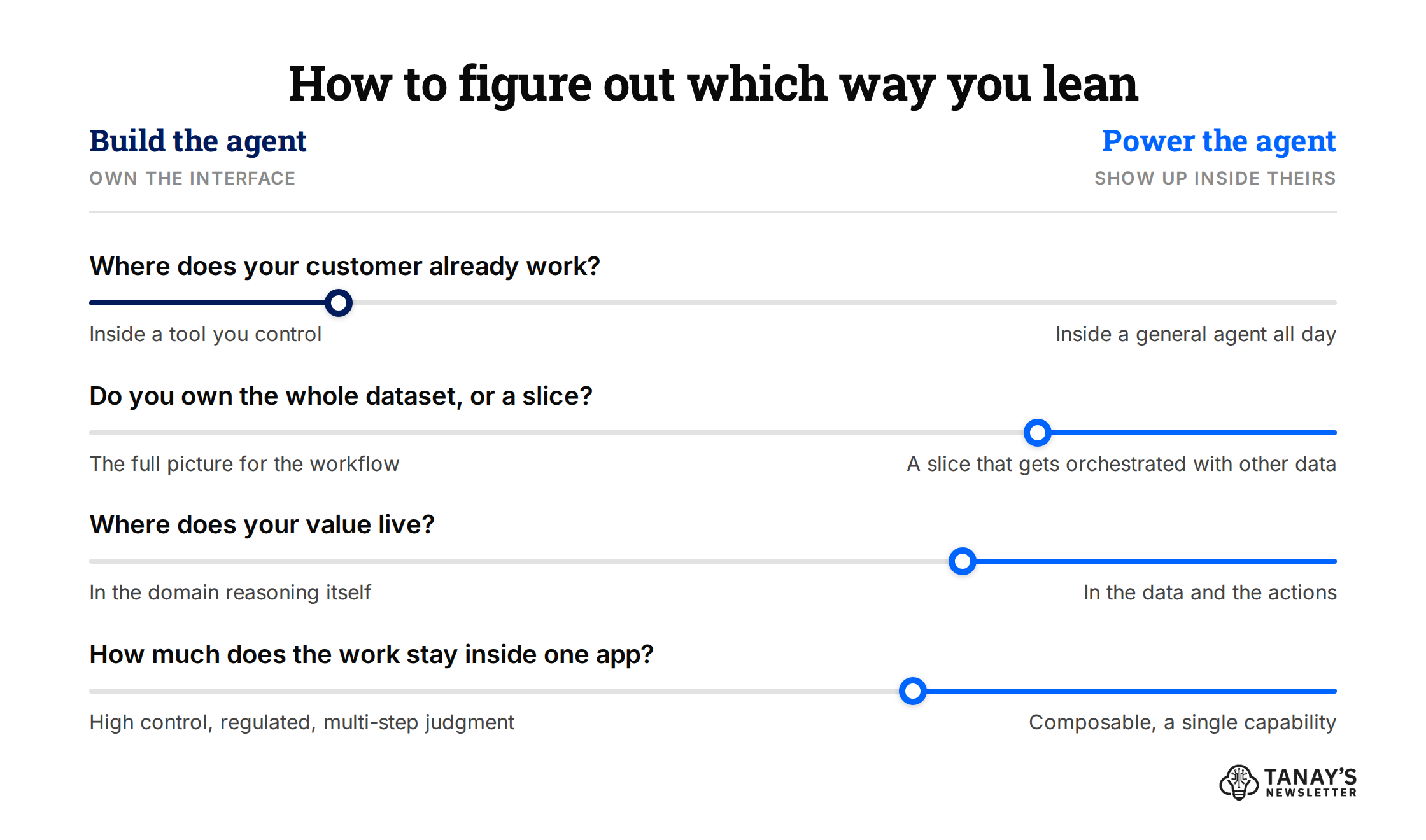
I think there are a few considerations for founders/builders to decide whether they should build an agent or power the agent.
Where does your customer already work? Inside a tool you control or inside a horizontal agent all day? The further toward the general agent, the more you should power it, because pulling them somewhere new is going to be challenging.
Do you own the whole dataset/workflow, or a slice? If you own the full picture for a workflow or set of workflows, you can credibly be the agent for it. If you own a slice that only becomes useful once it’s combined with other data, the orchestr
→ 原文存档